




Premium Table Linens: Elevate Every Table for Weddings, Restaurants and Hotels
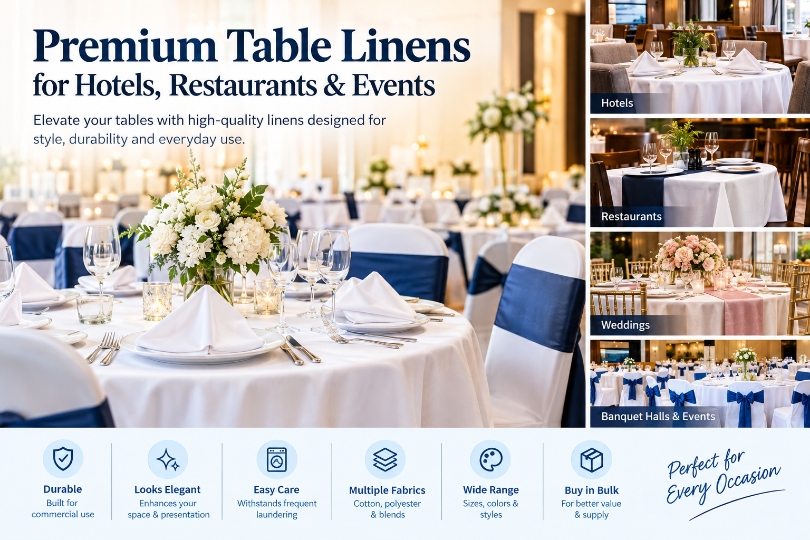
For hotel and restaurant managers, table linen is more than decoration. It affects presentation, service uniformity, laundry processing, replacement rates, and buying costs. Luxury table linens help hotels and restaurants, wedding venues, and event planners deliver an elegant dining experience time after time by choosing fabrics and weave types best suited to the commercial environment.
Understanding the Product
Commercial table linens include tablecloths, table napkins, placemats, runners, and chair covers designed for use on dining, banquet, and service tables in foodservice establishments. They are chosen for their appearance and/or ease of washing and ironing, as well as stable dimensions and durability.
Commercial-grade, as opposed to residential-grade, products are designed to endure repetitive handling, uniform sizing requirements, stock rotation procedures, and institutional laundering.
Fiber content is only the start of what matters in construction. A purchasing department must also consider fabric weight, weave, yarn quality, seam construction, hemming, finish, dimensional stability, and color retention. A pretty, visually pleasing cloth that distorts from repeated laundering may create more operating cost than its original per-unit price suggests.
Fire performance also needs to be carefully specified. NFPA 701 is a flame propagation test for textiles and films. Still, buyers should confirm whether the specific table linen and application require the relevant standard, and not assume every hospitality textile needs the same certification. The current edition of the standard has different requirements based on the material, construction, and end use.
Why the Hospitality Industry Uses Commercial Table Linens
In hospitality, tables get a beating that home dining rarely matches. It's common for a busy restaurant to turn over tables two or even three times in a single meal period. A hotel may shift linens from restaurants to meeting rooms and banquets. One event venue can process hundreds of pieces after a single function.
- Those four priorities differ for purchasing in this operating environment, that is:
- Replacement parts are the same size, color, and shape as those we have in stock.
- Cleaning Performance: We expect the fabric to hold up to washing and finishing approved by your facility.
- Durability: The item should withstand frequent use, washing, folding, and storage.
- Availability: It must be feasible to replace and restock for continued use.
For this reason, wholesale restaurant linens are normally evaluated as an operating supply rather than a one-time décor purchase. The same principle applies to hotel table linens, where standardization simplifies housekeeping, banquet, and purchasing workflows.
Key Benefits for Commercial Buyers
The financial gain from a properly implemented linen service comes from controlling total operating cost, not just from achieving the lowest unit cost.
Cost control: Standardizing sizes and fabrics eliminates unnecessary SKUs and simplifies purchasing.
Durability: Commercial-grade linen lasts longer, wears better, and is a better value than many consumer items.
Fewer replacements: Proper care and fabric choice eliminate many early retirements from over-shrinking, seam breakage, and fading.
For example, a hotel with 150 banquet tables should not determine its linen needs based solely on the number of tables. Consider service tables, clean backups, laundry turnaround, peak time, soiled pieces, and emergency spares.
That is where lifecycle cost becomes more useful than purchase price. A lower-priced textile that requires substantially more frequent replacement can cost more annually than a better-performing product.
Choosing the Right Product
Facility requirements: Properties using an industrial laundry should choose products that are compatible with the laundry's approved process. Properties that outsource laundry should communicate the same requirements to their laundry service provider.
For event-focused purchasing, evaluate wedding table linens against the venue's table inventory. Standardizing around the most-used tables can reduce the number of specialty sizes that must be stored.
For specific banquet applications, buyers can also review wholesale banquet tablecloths in different fabrics, colors, and sizes.
Hotels
Hotels often need linens that accommodate restaurants, dining, in-room service, conferences, weddings, and private events. A property may therefore need multiple sizes and styles within a single purchasing program.
Hotels should also establish replacement thresholds. Waiting until a large percentage of the inventory becomes unusable can create an emergency purchase with limited options.
For properties managing multiple table-linen requirements, a wholesale table linens program can help centralize tablecloths, napkins, skirts, chair covers, and related products.
Wedding Venues
Wedding services are driven by presentation, color consistency, and coordinated table settings. Wedding reception tablecloths can be combined with matching table napkins, runners, chair covers, and table skirts to achieve a consistent look and feel for an event.
For larger receptions, banquet tablecloths can provide standardized coverage across commonly used banquet tables.
Banquet Halls and Convention Centers
Banquet service largely depends on standard sizing. Banquet chair covers and sashes should be grouped by table type so table arrangers can easily find matching items.
A convention center could accommodate more than one event simultaneously. Color-coded bins, labeled shelves, and written par levels help reduce picking errors and increase room turnover.
Table skirts, runners, and specialty cloths should be inventoried separately because their replacement rates and event usage can differ significantly from standard tablecloths.
Commercial Laundry and Maintenance
Laundry performance is one of the most important determinants of linen lifespan.
Use the textile manufacturer's care instructions and the commercial laundry's validated process. Wash classification, detergent chemistry, water temperature, mechanical action, extraction, and drying conditions all influence fabric performance.
Best practices are included:
- Separate by color, degree of soil, and fabric type.
- Avoid overloading the washing machine, as this reduces mechanical action and cleaning efficiency.
- Use validated wash recipes rather than make-shift solutions for temperatures or chemical amounts.
- Control dryer temperature and drying time to reduce unnecessary thermal stress.
- Inspect hems and seams during folding.
- Remove heavily damaged pieces from active circulation instead of repeatedly returning them to service.
- Store clean linens in dry, protected conditions.
- Rotate inventory so that no item sits unused for extended periods.
Consider shrink resistance and color retention when you are evaluating your options for large-scale purchasing. Ideally, test a supplier's sample in your facility's actual laundering process before committing to a large standardized program.
Product Comparison
|
Factor |
Polyester |
Cotton |
Cotton-Polyester Blend |
|
Durability |
High |
Moderate to high |
High |
|
Wrinkle resistance |
High |
Lower |
Moderate to high |
|
Commercial laundering |
Generally straightforward |
Requires closer process control |
Generally straightforward |
|
Appearance |
Clean and consistent |
Natural, premium hand |
Balanced |
|
Dimensional stability |
Generally strong |
More sensitive to shrinkage |
Generally improved |
|
Typical use |
Restaurants, banquets, high-turnover operations |
Upscale dining, specialty events |
Hotels, restaurants, mixed hospitality |
|
Main consideration |
Hand and natural-fiber appearance |
Shrinkage and finishing |
Blend ratio and construction |
No single fabric suits every operation. The correct choice depends on service intensity, desired appearance, laundry process, replacement budget, and inventory requirements.
For buyers comparing premium fabrics and construction, the premium table linen collection includes cotton, polyester, and blended options for hospitality and event applications.
Common Buying Mistakes
Purchasing inconsistent fabric lots: Shade, weight, or finish changes may be noticeable when you place old and new pieces side by side.
Not anticipating replacement stock: Doing business with no reserve inventory increases your chances of emergency buying.
Buying based on unit price alone: A low purchase price does not equal a low life-cycle cost.
Complicating the SKU mix: Too many colors, sizes, and constructions can increase storage needs and make inventory management harder.
Buying Checklist
Before approving a bulk order, confirm:
- Construction of hem and seam
- Compatibility with commercial laundering
- Expectations for shrinkage
- Performance of the colorfastness
- Valid fire performance documentation
- Minimum inventory level
- Replacement policy
- Supplier inventory status
- Time to delivery
- Ability to order in bulk
- Delivery specifications
- Sample approval process
For buyers comparing different products in one place, the wholesale table linens collection includes tablecloths, napkins, table skirts, chair covers, placemats, runners, and other table-linen supplies.
Choosing a Reliable Wholesale Supplier
A commercial supplier should be evaluated on more than product range. Procurement teams need confidence that future replenishment will match the original specification.
Look for suppliers that can support:
- Responsive customer support
- Consistent product specifications
- Reliable inventory information
- Replacement and replenishment planning
- Bulk-order capabilities
- Appropriate product documentation
- Clear delivery expectations
For restaurants, the table linen collection includes table napkins, round and square tablecloths, banquet and fitted tablecloths, chair covers, table skirts, placemats, runners, and related table-linen products.
Final Thoughts
A good linen program balances appearance and function. Several factors, such as the right fabric, construction, dimensions, laundry process, and stock level, can help reduce the demand for replacements and keep tables consistent in restaurants, hotels, banquet halls, and more.
Procurement teams are not just buying beautiful textiles. Rather, it is about building a sustainable supply chain that, on the one hand, enables service-level and inventory efficiency and, on the other hand, delivers predictable lifecycle costs.
Quality table linens have commercial value when the look, feel, and maintenance match the business's needs.
For hospitality buyers comparing products, explore the premium table linens collection or the broader wholesale table linens collection.
Request product specifications or a bulk quote with your table sizes, quantities, and application.