




Lab Coats: How Can You Choose Based on Fabric, Fit, and Features?
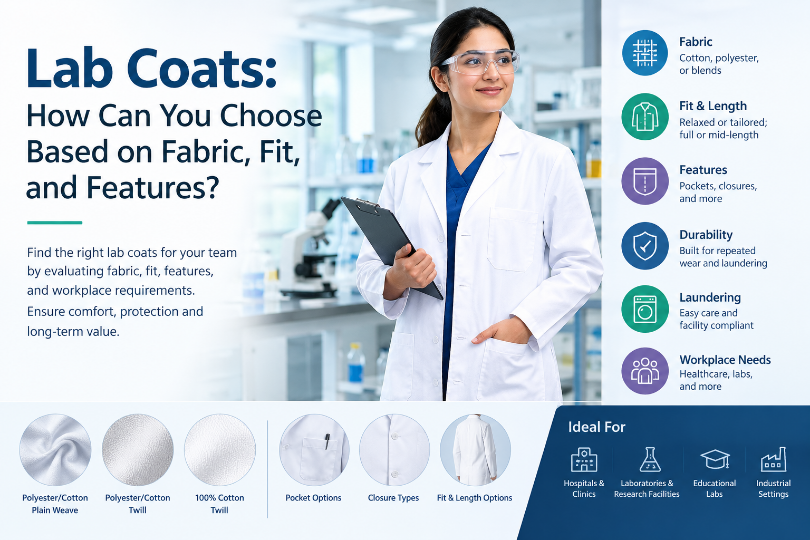
Choosing the right lab coats for a commercial facility requires more than selecting a white garment in the correct size. Procurement teams need to evaluate fabric construction, fit, pocket configuration, garment weight, laundering requirements, and the hazards associated with the work. For healthcare and laboratory environments, the right selection supports professional presentation, employee comfort, inventory consistency, and appropriate protective practices. HY Supplies’ collection includes cotton, polyester/cotton, and specialty constructions in multiple weights, fits, lengths, and pocket configurations.
Understanding the Product
A lab coat is a coat worn by professionals in the medical field or in laboratories as part of their daily work, to protect their skin and personal clothing from hazardous or infectious materials. Use a suitable coat type, based on the level of exposure risk, facility policy, and laundry program. Disposable to Reusable: varieties in commercial-grade lab coats and security legwear. Disposable business lab coats typically come in a thin polyester or polyester/cotton blend fabric and are normally one-size-fits-all. OSHA and CDC guidance on protective clothing is based on the hazards of the work, not whether the coat is interchangeable.
Commercial-grade coats are not like traditional apparel; they are different because purchasing decisions must consider that products need to withstand repetitive wear, staff needs to move freely, multiple pockets are required for carrying equipment, the sizing must be consistent, coats must be laundered and replaced, as well as accommodate division- or hospital-specific PPE protocols. HY Supplies offers a variety of styles, including traditional relaxed cuts, contemporary tailored styles, two-, three-, and five-pocket configurations, full- and mid-length options, and fabrics ranging from 4.25 oz polyester/cotton plain weave to 8 oz 100% cotton twill.
Why the Industry Uses This Product
Healthcare facilities, diagnostic laboratories, research laboratories, educational laboratories, and some industrial settings use protective outer garments to help prevent contamination of personal clothing and control workplace exposure.
CDC guidance for clinical and public health laboratories recommends laboratory coats and other PPE based on site-specific risk assessment and standard operating procedures. OSHA laboratory guidance also considers protective clothing as one element in a hierarchy of controls. A coat is not an engineering control, a safe work practice, appropriate gloves, eye protection, ventilation, or other controls necessary for the hazard. For chemicals, the protective qualities of the garment must be related to the exposure, not just assumed from the term "lab" or from the fabric composition.
Key Benefits
Proper selection can add consistency to operations without adding unnecessary complexity.
Durability: Fabric weight and construction are two of the biggest factors in how well a garment stands up to normal wear and tear. HY Supplies offers options from lightweight 4.25 oz polyester/cotton plain weave to heavier 8 oz cotton twill so that buyers can choose garment weight based on operational needs.
Inventory efficiency: A few approved styles and standardized size ranges can make ordering, stocking, distributing, and replacing easier.
Operational consistency: Selecting a coat style and pocket configuration that matches the job function helps ensure employees receive garments appropriate for the job.
Lifecycle value: A garment that remains serviceable through the facility’s normal laundering and replacement cycle can reduce avoidable replacement activity.
Choosing the Right Product
Start With Fabric
Select lab coat fabric based on the work environment rather than appearance alone.
Polyester/cotton plain weaves are represented across several weights in the HY Supplies collection, including 4.25 oz, 4.6 oz, and 5.5 oz constructions. The collection also includes polyester/cotton twill and 8 oz 100% cotton twill.
A material name alone does not establish chemical resistance, fluid resistance, flame resistance, or biological protection. Verify those properties in the manufacturer’s technical documentation when required.
Evaluate Fit and Length
Lab coat fit should allow the employee to perform normal tasks without excessive restriction while providing appropriate coverage.
HY Supplies lists both classic relaxed and modern tailored fits. It also offers full-length and mid-length formats.
Procurement teams should assess fit across the workforce rather than on a single sample wearer. A functional size-set assessment can determine whether the chosen selection suits most staff and whether additional sizes are needed.
Match Features to the Job
Pocket configuration is an operational consideration, not just a styling element.
Some technicians who carry pens and small work items may require a chest pocket with a pen divider. Other positions may require several patch pockets. HY Supplies offers two-, three-, and five-pocket configurations.
Closures also differ. Buttons, snaps, or other closure systems may be used, depending on the garment. Selection should be based on facility requirements, job type, laundering process, and the level of protection needed.
Healthcare and Laboratory Applications
Hospitals, clinics, diagnostic labs, medical centers, research institutions, and educational laboratories represent the most immediate commercial markets for this category. HY Collections includes these garments in its healthcare dress collection , with medical scrubs and warm-up jackets.
In healthcare procurement, the selection process must consider the following: staff role, risk of exposure, level of coverage needed, facility laundering, and replacement plan. The biosafety risk assessment should address whether a laboratory coat is sufficient or whether additional protective clothing is needed. CDC guidance contains a clear focus on task- and site-specific PPE selection.
Clothing requirements in hospitality are generally different. A hotel, restaurant, or event center would typically choose chef coats, aprons, housekeeping uniforms, or other hospitality workwear, not lab coats, unless there is a specific lab or testing function associated with the business. HY Supplies divides hospitality workwear and healthcare apparel into two different categories to reflect the varying needs of these industries.
Commercial Laundry and Maintenance
A facility’s laundry program should be considered before finalizing a garment specification.
For reusable protective clothing, the laundering process should be established around the type of contamination, garment instructions, facility procedures, and applicable workplace requirements. CDC guidance states that potentially contaminated reusable laboratory clothing should be laundered through the institution rather than taken home.
Product Comparison
|
Selection factor |
Polyester/Cotton Plain Weave |
Polyester/Cotton Twill |
100% Cotton Twill |
|
Typical construction |
Lightweight to midweight plain weave |
More substantial twill structure |
Heavier cotton twill option |
|
Example HY Supplies weights |
4.25, 4.6, 5.5 oz |
Multiple weights listed |
8 oz |
|
Primary consideration |
Lower garment weight and routine wear |
More substantial workwear construction |
Natural-fiber twill preference |
|
Best suited to |
General healthcare/lab work where appropriate |
Facilities preferring twill construction |
Work environments where cotton construction fits requirements |
|
Selection priority |
Balance weight, fabric, fit and laundering |
Match weight to workload |
Verify laundering and facility requirements |
Common Buying Mistakes
Choosing based only on appearance: A professional-looking coat still needs to match the work environment and facility requirements.
Selecting based on unit cost alone: The purchase price is only a portion of the lifecycle cost.
Disregarding fit: Badly fitting clothing can lead to unnecessary restrictions of movement and make size management more complicated.
Equating fabric with protection: The fact that a fiber composition does not inherently possess chemical, liquid, biological, or flame-resistant treatment.
Not considering replacement stock: If you don't have a stockpile, a torn or soiled garment can beât "a operational immediate problem; the solution is to replace the Garment.
Neglecting washing: This garment must be suitable for use in the actual care facility with the care provider’s standard processes and manufacturer instructions.
Choosing a Reliable Wholesale Supplier
A vendor needs to be judged on more than just catalog coverage.
For continuous standard programs, buyers require reliable product identification, stable specifications, available sizes suitable for use, support for bulk purchases, and a well-defined method of replenishment. HY Supplies' selection of lab coats is now available in various fabric weights and styles to meet your needs, ranging from basic options to Landau-branded and more, such as different fits, lengths, pocket configurations, and many more construction options in one category.
For the enterprise, the focus is on bringing entire staff lines full circle with a complementary range of healthcare apparel and more, including medical scrubs, scrub pants, and warm-ups for larger healthcare program needs.
Conclusion
Correctly designed lab coat programs could simplify lab coat inventory, encourage a more uniform staff appearance, and give a purchasing group a more transparent end-of-life and laundering plan. Before placing a bulk order, evaluate how fabric construction, fit, features, facility needs, and supplier capability meet real-world use.
Take a look at HY Supplies’ collection of lab coats or check out its healthcare textiles and medical apparel sections for a more comprehensive staff attire solution.