




Different Types of Patient Gowns Used in Hospitals: Uses & Buying Guide
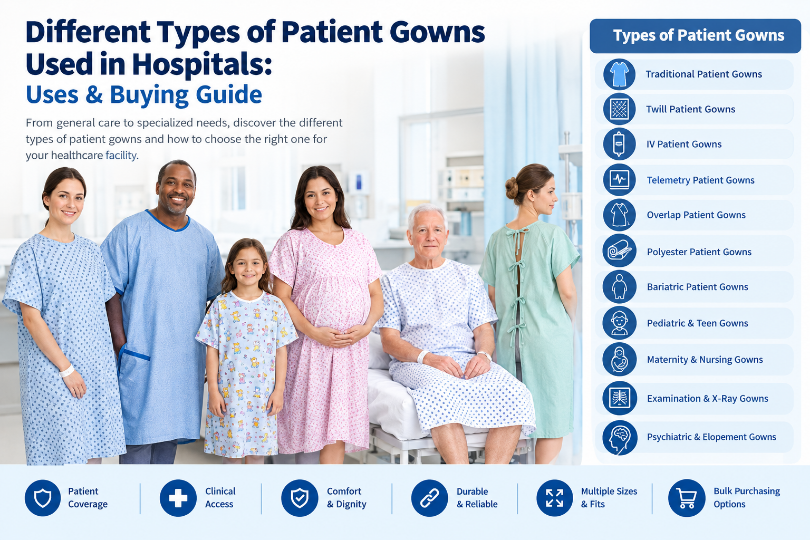
Patient gowns are a common part of hospital and healthcare settings. They are designed to provide appropriate patient coverage while giving healthcare professionals access to areas of the body during examinations, treatments, procedures, monitoring, and other forms of care.
Yet, not all hospital gowns are designed for the same function. Standard patient gowns, IV gowns, bariatric gowns, pediatric gowns, examination gowns, maternity gowns and behavioral-health gowns differ in fabric, size, closure, coverage and access options.
Knowledge of the various kinds of patient gowns can assist hospitals, clinics, nursing homes, and other healthcare providers in choosing gowns that are suitable for their patients and day-to-day operations.
Why Are Patient Gowns Used in Hospitals?
Patient gowns are primarily designed around two requirements: patient coverage and clinical access.
Depending on the patient's condition and the type of care being provided, a gown may make it easier for healthcare professionals to:
- Perform physical examinations
- Access areas of the body during treatment
- Administer or monitor IV therapy
- Connect monitoring equipment
- Perform diagnostic procedures
- Change patients more efficiently
- Provide appropriate patient coverage and comfort
The type of gown required can therefore vary between general inpatient care, diagnostic departments, surgical settings, maternity care, pediatric units, behavioral-health environments, and other healthcare applications.
It is also necessary to differentiate a patient gown from an isolation or protective gown. Patients normally wear patient gowns, while isolation and protective gowns are intended for defined infection-control or barrier uses.
What Makes a Good Hospital Patient Gown?
Healthcare facilities typically consider several factors when selecting patient gowns.
Comfort and Coverage
Patients may need to wear a gown for a short examination or for an extended hospital stay. Appropriate sizing, fabric selection, and coverage can therefore affect comfort and dignity.
Clinical Access
Some gowns are designed with features that make it easier to access IV lines, monitoring equipment, or specific areas of the body without completely removing the garment.
Durability
Reusable gowns may be exposed to frequent laundering and repeated use. Fabric construction and stitching should therefore be considered when evaluating gowns for institutional use.
Closure Design
Gowns may have various types of closures, such as ties, snaps, an overlap design or other configurations. The type of closure is determined by the specific use of the gown and access needed.
Size and Fit
Healthcare facilities may need standard, bariatric, pediatric, teen, or other specialized sizing to accommodate different patient populations.
What Are the Different Types of Patient Gowns Used in Hospitals?
Hospitals and healthcare centers have different varieties of patient gowns available for different patient requirements and clinical settings.
1. Traditional Patient Gowns
Traditional patient gowns are commonly used for general patient care, examinations, and hospital stays.
They typically use a straightforward back or angle-back closure and may be manufactured from cotton-polyester blends or other healthcare textile fabrics.
HY Supplies offers wholesale hospital patient gowns in different sizes, colors, patterns, fabrics, and closure configurations.
2. Twill Patient Gowns
Twill patient gowns are made from twill fabric, which can provide a durable construction for repeated institutional use.
These gowns may be appropriate for healthcare facilities that need reusable garments for general patient care.
Healthcare facilities can review available wholesale hospital patient gowns to compare suitable patient-gown options.
3. IV Patient Gowns
IV gowns are designed to make access to IV lines easier while allowing the patient to remain covered.
Depending on the design, these gowns may include snap sleeves, side ties, angle-back closures, or other features that facilitate clinical access.
HY Supplies' wholesale hospital patient gowns collection includes gown styles with features such as snap sleeves and different closure configurations.
4. Telemetry Patient Gowns
Patients receiving cardiac or other forms of monitoring may require gowns designed around monitoring equipment.
Telemetry gowns can include pockets or construction features intended to accommodate monitoring devices while allowing healthcare staff to access the patient when needed.
HY Supplies currently lists patient-gown options designed with features that can support clinical access and monitoring requirements. Facilities can explore the patient gown collection for available styles.
5. Overlap Patient Gowns
Overlap gowns offer more coverage because of their overlapping design.
They may be useful when modesty, coverage and ease of garment removal are important.
Healthcare facilities looking for different closure and coverage configurations can review the wholesale hospital patient gowns available from HY Supplies.
6. Polyester Patient Gowns
Polyester hospital gowns are also available and suitable for hospital use.
Fabric selection can affect durability, care, appearance, and other attributes of the garment. Facilities should choose fabrics that are suitable for the intended purpose and laundering requirements.
HY Supplies currently lists 100% polyester patient-gown options within its patient-gown collection.
7. Bariatric Patient Gowns
Bariatric gowns are designed with larger dimensions to provide appropriate coverage and comfort for patients who require extended sizing.
A properly sized gown can make patient movement, examination, treatment, and changing more practical while helping maintain dignity.
HY Supplies maintains a dedicated bariatric patient gown category for healthcare facilities requiring extended-size patient gowns.
8. Pediatric and Teen Patient Gowns
The size and pattern of gowns needed for children and teenagers may be different from those used for adults.
Pediatric and youth gowns can be used in children's hospitals, pediatric departments, outpatient facilities, and other healthcare environments serving younger patients.
Healthcare facilities can explore Pediatric & Youth Hospital Gowns for patient-gown options designed for younger patients.
9. Nursing and Maternity Gowns
Maternity and nursing gowns are designed around the needs of patients receiving maternity or postpartum care.
Depending on the design, nursing gowns may include openings or slits intended to provide easier access for breastfeeding or clinical care while maintaining appropriate coverage.
HY Supplies lists maternity gowns with nursing slits within its healthcare-gown category structure.
10. Examination and X-Ray Gowns
Test robes are commonly worn when performing physical examinations and laboratory tests.
X-ray gowns may be made for the diagnostic suite, with the manufacturing methods employed to provide function while allowing access needed for the imaging process.
Healthcare facilities can explore examination and X-ray gowns for gowns intended for examination and diagnostic applications.
11. Psychiatric and Hi-Risk Elopement Gowns
Behavioral-health environments can have different garment requirements from general hospital units.
Hi-risk elopement and psychiatric gowns are designed for specialized behavioral-health applications and may use different construction and materials based on the facility's requirements.
These gowns should be selected according to the healthcare facility's policies, patient-safety procedures, and intended application.
HY Supplies has a dedicated hi-risk elopement and psych gowns category for behavioral-health applications.
Patient Gown Types at a Glance
|
Patient Gown Type |
Common Application |
Important Considerations |
|
Traditional patient gown |
General hospital care |
Coverage, closure, fabric |
|
Twill patient gown |
General patient care |
Durability and laundering |
|
IV patient gown |
IV therapy |
IV-line access |
|
Telemetry gown |
Patient monitoring |
Monitoring-device access |
|
Overlap gown |
General patient care |
Additional coverage |
|
Polyester gown |
Institutional healthcare use |
Fabric and laundering requirements |
|
Bariatric gown |
Larger patients |
Extended sizing and coverage |
|
Pediatric gown |
Children's healthcare |
Youth sizing and fit |
|
Maternity/nursing gown |
Maternity and postpartum care |
Nursing/clinical access |
|
Examination/X-ray gown |
Diagnostic procedures |
Examination and imaging access |
|
Psychiatric/elopement gown |
Behavioral-health settings |
Specialized safety requirements |
How Do You Choose the Right Patient Gown?
Healthcare facilities should consider the intended application rather than selecting a single gown style for every department.
Consider the Patient Population
Determine whether the facility needs gowns for:
- Adults
- Pediatric patients
- Teenagers
- Bariatric patients
- Maternity patients
- Behavioral-health patients
Consider the Clinical Application
Think about whether the gown will be used for:
- General inpatient care
- Physical examinations
- IV therapy
- Patient monitoring
- Diagnostic imaging
- Maternity care
- Behavioral-health applications
Consider Fabric and Laundering
For reusable hospital gowns, facilities should evaluate fabric composition, construction, laundering requirements, expected frequency of use, and durability.
Consider Closure and Access
Ties, snaps, overlap construction, side openings, and other closure configurations can affect how quickly healthcare staff can access the patient.
Consider Bulk Purchasing Requirements
Hospitals and healthcare organizations purchasing gowns in volume may also need to evaluate:
- Case-pack quantities
- Available sizes
- Available colors and patterns
- Fabric composition
- Product availability
- Reordering requirements
- Shipping considerations
For facilities comparing different gown styles and purchasing requirements, the patient gowns wholesale category provides a broader view of available patient-gown options.
Patient Gowns vs. Isolation and Protective Gowns
Patient gowns should not automatically be treated as interchangeable with isolation or protective gowns.
A patient gown is primarily intended for the person receiving care. Isolation and protective gowns are used for specific barrier and infection-control applications.
Healthcare facilities should therefore select the garment based on its intended clinical function and applicable facility protocols.
For facilities evaluating different protective and healthcare garment options, see the wholesale healthcare gowns collection.
What Should Hospitals Look for When Buying Patient Gowns in Bulk?
When purchasing patient gowns for a hospital or healthcare facility, purchasing teams should evaluate more than the initial unit price.
Important factors include:
- Gown type – Select the design according to the intended clinical application.
- Sizing – Make sure the range accommodates the facility's patient population.
- Fabric – Compare cotton blends, polyester, twill, and other available constructions.
- Closure – Consider ties, snaps, overlap designs, and access requirements.
- Durability – Reusable garments should be suitable for the facility's laundering process.
- Coverage – Consider patient comfort, privacy, and clinical access.
- Case quantities – Confirm pack and case configurations before ordering.
- Availability – Consider lead times and ongoing replenishment requirements.
For facilities evaluating multiple styles, wholesale patient gowns are available for healthcare applications.
Choosing Patient Gowns for Your Healthcare Facility
The right patient gown depends on the patient's needs, clinical application, facility requirements, and garment specifications.
A general patient gown may be appropriate for routine care, while IV, telemetry, bariatric, pediatric, maternity, examination, or behavioral-health gowns may be better suited to specialized applications.
Healthcare purchasing teams can review different patient gown types and compare fabric, sizing, closures, coverage, and intended use before placing a bulk order.
For healthcare facilities comparing different gown categories, wholesale hospital patient gowns provide a starting point for reviewing available styles and configurations.