




Best Fabric for Lab Coats: Cotton, Polyester, and Poly-Cotton Compared
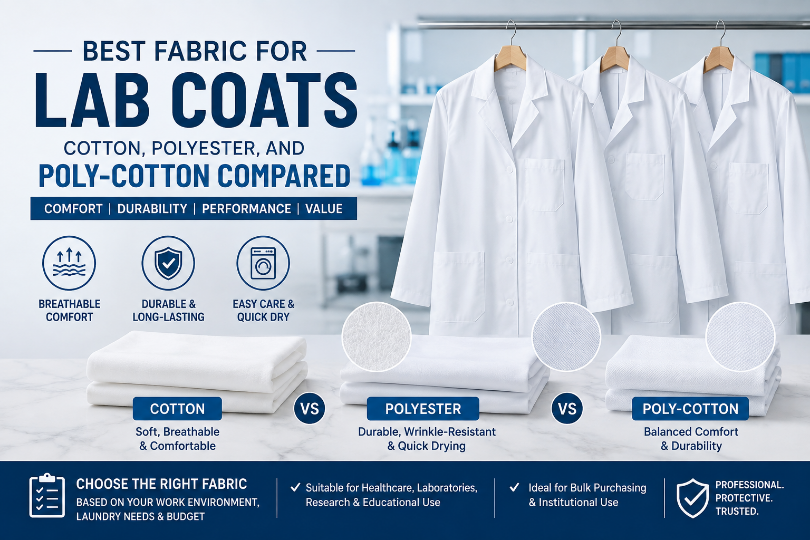
Selecting laboratory clothing is a matter of operational necessity and not simply a uniform preference. Hospitals, diagnostic labs, universities, research centers, pharmaceutical companies, and countless other healthcare-related facilities require lab coats that provide the right combination of comfort, durability, launderability, appearance, and job-specific protection. Determining the best material for lab coats is influenced by many factors, including the work area, exposure pattern, laundry method, replacement frequency, and procurement conditions. For industrial use, cotton, polyester, and blends of these fabrics offer specific benefits.
Understanding Lab Coat Fabric
Lab coats are protective or professional clothing in the form of a coat worn over clothing to cover the torso and arms, intended for scientific laboratory, clinical, research, medical, and healthcare use. What you choose should depend on the risk and level of exposure you expect; the Occupational Safety and Health Administration stresses that protective clothing should be chosen based on the task and extent of exposure, rather than assuming one material will suffice for all situations. For purchasing teams, the critical comparison is: 100% cotton lab coats or polyester and poly-blend construction:
|
Fabric |
Primary Strength |
Main Limitation |
Typical Commercial Fit |
|
100% Cotton |
Breathability and natural comfort |
Greater shrinkage and slower drying |
Clinical, teaching, research environments |
|
Polyester |
Durability, dimensional stability, quick drying |
Less breathable than cotton |
High-volume institutional use |
|
Poly-Cotton Blend |
Balance of comfort and durability |
Performance depends on blend ratio |
Broad healthcare and laboratory use |
A lab coat must not be used as a substitute for the recommended chemical protective clothing. OSHA suggests that you should take into account the protective qualities in relation to the specific hazard. If there is a possibility of significant skin contact, an additional protective garment should be worn.
Why Healthcare and Laboratory Facilities Use Lab Coats
Laboratory and healthcare environments are high-stress ones. Garments may be laundered or dry-cleaned, may be worn in hard use for long periods, may be stained or contaminated, and may be subjected to multiple commercial laundering cycles.
Procurement teams, satisfaction of the end customer, and uniformity of the product are equally important. A hospital buying a hundred coats needs reliable sizing, fabric construction, color, seam quality, and availability for replacement. A clinical laboratory may prioritize durability for frequent laundering and dimensional stability, whereas a teaching laboratory may value comfort and cost containment more.
Where laboratory coats function as PPE, employers must select and maintain appropriate protective clothing based on anticipated hazards. OSHA also states that laboratory coats and similar protective garments used as PPE should be laundered by the employer rather than sent home with employees.
Key Benefits of Selecting the Right Fabric
Selection of fabric has an effect on more than just the employee s comfort. It affects how often you replace it, cost of cleaning, required inventory and the length of service that each piece of cloth can provide.
Durability: Polyester and many poly-blend fabrics can withstand frequent washing and drying, making them ideal for busy healthcare environments.
Manage costs: The lowest unit cost might not be the lowest overall cost. A coat that needs to be replaced often might cost more per year than a sturdier coat that costs more up front.
Efficient inventory: Consistent sizing/dimensional stability allows for consistent stocking across the board. Operational consistency : One or two designated fabrications to establish purchasing, laundering, replacement, and employee pooling efficiencies.
Lifecycle value: Purchase price, expected service life, laundry requirements, replacement rate and administrative handling should be considered together as a total cost of ownership by buyers.
Cotton vs Polyester vs Poly-Cotton Lab Coats
A lab coat fabric comparison is most useful when evaluated against the facility's actual operating conditions rather than against a single universal ranking.
|
Factor |
Cotton |
Polyester |
Poly-Cotton |
|
Breathability |
Excellent |
Moderate |
Good |
|
Moisture comfort |
Good |
Moderate |
Good |
|
Dimensional stability |
Moderate |
Excellent |
Good–Excellent |
|
Drying speed |
Slower |
Faster |
Moderate–Fast |
|
Repeated laundering |
Good with proper care |
Excellent |
Excellent |
|
Wrinkle resistance |
Lower |
Higher |
Higher |
|
Shrinkage control |
Requires attention |
Strong |
Strong |
|
Long-term institutional use |
Good |
Excellent |
Excellent |
|
Overall versatility |
Good |
Good |
Excellent |
Cotton Lab Coats
100% cotton lab coats tend to be the most popular where breathability and the comfort of natural fibers are considerations. Cotton has a well-known feel and behaves appropriately in situations where workers create their own coats over a long period of time.
Maintenance is the trade-off. Cotton can shrink if washing and drying temperatures are not controlled, and it takes longer to dry than polyester does. Confirm with the manufacturer’s care instructions for use in your industrial laundry, and develop a consistent protocol.
Cotton is thus a good choice for applications where the wearer's comfort is of high operational value and laundry controls are well established.
Polyester Lab Coats
Polyester lab coats are attractive for facilities focused on durability, dimensional stability, wrinkle resistance, and efficient laundering. Polyester fibers generally dry faster and retain their dimensions well through repeated washing.
This makes polyester especially suitable for high-turnaround centralized laundry facilities. The trade-off is comfort: tightly woven polyester can be warmer and less breathable than cotton.
So the fabric weight and weave, along with the fiber content , should be taken into consideration when buying in bulk for high-volume institutional orders.
Poly-Cotton Lab Coat Blends
A poly-cotton lab coat blend is a mixture of both fibers. Blended fabrics tend to provide a reasonable balance of comfort, durability, drying performance, and dimensional stability for many healthcare and laboratory purchasing initiatives. They are also handy if a single standardized dress is required across different departments.
Choosing the Right Lab Coat
The most appropriate specification begins with the work, not the fabric label.
Evaluate:
* Fabric content: Is the work environment best suited for cotton, polyester, or a combination of the two?
* Weight of Fabric: Constructing the garment from lightweight woven or knit fabrics enhances comfort, whereas this tends to be the opposite effect with heavier materials.
* Weave and construction: Assess seam integrity, pocket placement, closure type and ease, reinforcement.
* Fit and sizing: Use of uniform sizing throughout facilitates stock control and reduces returns.
* Laundry process: Ensure that the product is compatible with the customer's washing, drying and finishing methods.
* Exposure Profile: Chemical splashes, biological contamination, heat, or other hazards can require specialized protective clothing.
Compliance requirements: Confirm applicable workplace and facility requirements before specifying a garment as PPE.
A product advertised as a "chemical-resistant lab coat" should not be chosen based on fiber content alone. Material, garment design, chemical type, concentration, exposure time and test performance all influence chemical resistance. OSHA specifically states that the protective clothing should be commensurate with the hazard.
Commercial Applications
Healthcare Facilities
Lab coats are worn by medical professionals, including doctors and nurses, as well as by scientists and students engaged in clinical, research, and laboratory activities. Consistency in sizing, professional look, laundering compatibility, and reliable replenishment are among the major considerations for purchasing departments.
Universities and Research Institutions
Teaching or research labs often need to order in bulk for multiple departments. Consistent fabric and sizing simplify purchasing and allow the administration to better control uniform replacement stock.
Pharmaceutical and Biotechnology Facilities
More specialized protective apparel may be necessary to cover these processes. Routine work activities may require standard lab coats, while work at higher risk levels should be performed with garments they have selected or evaluated for potential exposure risks.
Commercial Laundry and Maintenance
The life of a lab coat is directly affected by the laundry process. Cotton garments require special consideration regarding shrinkage and drying temperatures, while polyester and poly-cotton garments usually have greater dimensional stability.
There should be established uniform practices for the following:
- Sorting contaminated and non-contaminated garments according to facility policy.
- Following manufacturer laundering instructions.
- Avoiding excessive drying temperatures.
- Inspecting seams, cuffs, closures, and pockets during processing.
- Removing damaged garments from active inventory.
- Maintaining clean and soiled garment separation.
- Tracking garment rotation and replacement.
When lab coats are used as PPE in covered circumstances, the employer may be responsible for laundering. OSHA's bloodborne pathogens guidance specifically addresses employer laundering of laboratory coats, uniforms, and similar garments used as PPE.
Procurement Considerations and Total Cost of Ownership
A facility purchasing 25 coats has different procurement economics from one maintaining 500 coats across multiple departments.
Before ordering, calculate:
Required inventory = active users + laundry rotation + replacement reserve
A facility with centralized laundering may need additional garments to cover the time coats are in processing. Procurement teams should also maintain a reserve for new employees, damaged garments, size changes, and unexpected replacement demand.
TCO should include:
- Initial garment cost
- Expected service life
- Laundry and drying requirements
- Replacement frequency
- Storage requirements
- Freight and fulfillment
- Administrative purchasing time
For example, choosing a slightly higher-priced poly-cotton coat that remains dimensionally stable through repeated laundering can produce better lifecycle economics than repeatedly replacing lower-cost garments that shrink, lose shape, or wear prematurely.
Common Buying Mistakes
* Selecting household-grade clothing: Commercial clothing requires the construction of the garment to be suitable for wear in an institutional setting.
* Unit price shopping only: The least expensive coat may end up costing a lot if the rate of replacement is high.
* Overlooking the wash process: How well a fabric performs is partly dependent on how the item is washed and dried.
* Making every lab coat PPE: Protection needs to be appropriate to the hazard.
* Not budgeting for replacement inventory: Facilities need to have stock on hand for emergency use and cannot just order for the number of people they have on-site.
* Allowing for non-uniform fabric lots: Variations in fiber content, weight, size, or construction can disrupt standardized uniforms.
Buying Checklist
* Verify the fiber content and construction of the fabric.
* Choose the right fabric weight.
* Ensure size availability across the workforce.
* Test for seam, pocket, and closure strength.
* Check that the item is suitable for commercial laundering.
* Measure shrinkage and dimensional stability.
* Assess capacity to fill and deliver in volume.
* Solicit specifications or samples before a large uniform order.
Choosing a Reliable Wholesale Supplier
Product Quality Is Not the Only Thing That Matters in Supplier Reliability for Institutional Buyers. A good wholesale supplier will be able to maintain consistent specifications for repeat orders, clearly communicate lead times, handle bulk fulfillment, and provide product documentation.
Final Thoughts
For procurement teams, the best fabric for lab coats is ultimately the construction that performs consistently within the facility's operating model while meeting applicable protection requirements. Evaluate the fabric alongside garment construction, laundry procedures, inventory rotation, and total cost of ownership before committing to a bulk program.
Explore the lab coat collection, request product specifications, or ask for fabric samples before placing a larger institutional order.