




Best Hotel Bathrobes: Comparing Terry, Velour, Waffle, and Kimono Styles
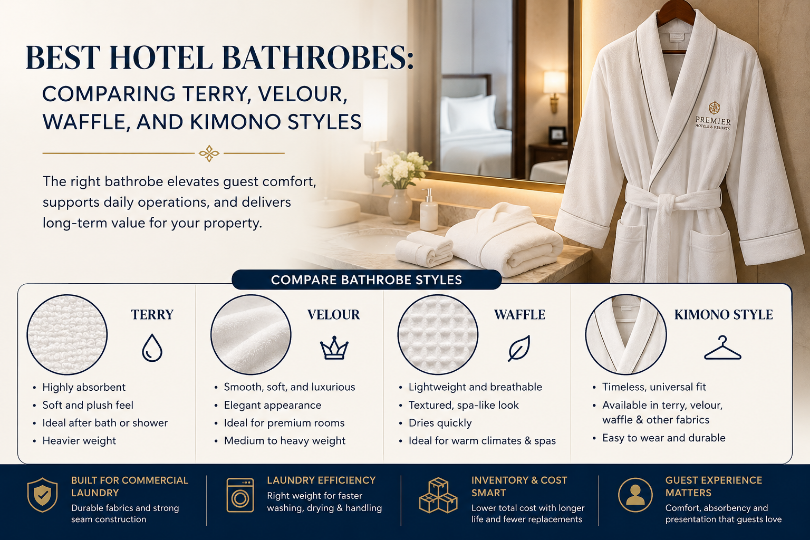
Hospitality bathrobes aren't just an amenity; they become part of a property's linen inventory, guest room presentation, and laundry operations. Best hotel bathrobes are chosen by aligning design, fabric, weight, care, and guest experience with property operations. Terry, velour, waffle, and kimono designs serve different purposes. For purchasing departments, the right decision is not necessarily the softest robe or the lowest unit cost. It is the design for the guest that meets the laundry throughput, storage, replacement cycle, and budget and delivers the required guest presentation.
Understanding the Product
Terry cloth bathrobes are an excellent choice when high absorbency is needed, and you want the feel of a familiar towel. Velour bathrobes have a softer, more decorative face and are generally chosen when presentation is more important. Waffle-weave robes bring out texture and can create a lighter visual and tactile feel. Kimono-style bathrobes refer to the design of the gown, not the material; hence, a kimono-style robe can be made from waffle, terry, or several other materials.
Weight: Assess weight in relation to use. Heavier robes can enhance the guest experience, but they also exponentially increase the fabric weight to be washed, dried, stored, and hauled on housekeeping carts. Lightweight hotel robes may be better suited for warm climates, spa facilities, and hotels that can accommodate high guest turnover.
Robes made from absorbent cotton can be a great choice if you want to bathe and get dry in that order. Terry is also the simplest choice if the robe will be used to dry off after a bath or shower. Velour is great when a smoother face and visual presentation are required. Waffle is good when you need texture, something lightweight, and a spa look.
Commercial laundering is part of product selection. Ask for care, dimensional stability, seam construction, and laundering recommendations. If you send for your laundry, send them the detailed specification well in advance of the rollout.
Why the Industry Uses This Product
Hotels and resorts employ robes to extend the guest experience beyond the bed and bath. A robe can enhance spa access, pool use, in-room lounging, or a presentation in a premium room. Properties that promote luxury hotel robes should match the robe's quality to the overall level of guest service.
On the operational side, the robe is added to the linen inventory. Procurement will need to simulate room occupancy, laundry turnaround, and spare parts. Robust, commercial programs generally standardize one or two types of robes. It also simplifies cleaning and maintenance, as well as storage, room checks, restock, and replacement purchase.
Key Benefits
Commercial value is determined by lifecycle cost, not invoice price. A lower-cost robe becomes expensive when replacement, storage, or laundering costs are high. A heavier robe also increases laundry and drying loads when a lighter option would suffice.
Inventory efficiency matters. A 200-room hotel that places robes in 25% of rooms needs a different opening stock than a resort that provides one in every room, plus spa inventory. Model occupancy, laundry turnaround, loss, damage, and replacement rates before ordering.
Choosing the Right Product
Terry cloth bathrobes are an excellent choice when high absorbency is needed, and you want the feel of a familiar towel. Velour bathrobes have a softer, more decorative face and are generally chosen when presentation is more important. Waffle-weave robes bring out texture and can create a lighter visual and tactile feel. Kimono-style bathrobes refer to the gown's design, not the material; hence, a kimono-style robe can be made from waffle, terry, or several other materials.
Weight: Assess weight in relation to use. Heavier robes can enhance the guest experience, but they also exponentially increase the fabric weight to be washed, dried, stored, and hauled on housekeeping carts. Lightweight hotel robes may be better suited for warm climates, spa facilities, and hotels that can accommodate high guest turnover.
Robes made from absorbent cotton can be a great choice if you want to bathe and get dry in that order. Terry is also the simplest choice if the robe will be used to dry off after a bath or shower. Velour is great when a smoother face and visual presentation are required. Waffle is good when you need texture, something lightweight, and a spa look.
Commercial laundering is part of product selection. Ask for care, dimensional stability, seam construction, and laundering recommendations. If you send for your laundry, send them the detailed specification well in advance of the rollout.
Hotels
Comfort, appearance, storage, and laundry efficiency are the key factors that hotels usually require in their guest room linen. Housekeeping inventory is simplified by a small set of standard sizes and styles.
High-end properties can choose velour or heavyweight terry for their luxury rooms, and waffle or lighter constructions for the rest of the hotel rooms. The decision should be based on how the guests actually use the room, not on the room rate.
Resorts and Spas
Spas often love the robe feel, texture, and look. Waffle or velour spa robes can enhance a chill-out vibe, while terry is a reliable companion for a robe if you need more absorbency on a day-to-day basis.
If the turnover for spa is different, then the spa and room inventories should be separated in the property. A separate spa stock count provides a buffer to prevent robes from being swept into general housekeeping inventory and allows for easier replenishment forecasting.
Wedding and Event Venues
Suites, bridal prep areas , or wellness facilities at event venues that have them may offer robes. Reserve stock for above-average needs and order a robe that fits those needs.
The inventory should be scaled to the number of simultaneous events, the potential maximum occupancy per suite, the laundry turnaround, and the expected rate of exhaustion. A small reserve is especially critical in situations where robes are included in a contracted guest package.
Commercial Laundry and Maintenance
The actual wash-and-dry process determines the performance of commercial laundry, not just the name of the fiber. Follow the manufacturer's care instructions and test the selected robe using your property's or contracted laundry’s chemistry, temperatures, extraction, drying, and finishing methods.
Drying, in particular, deserves close attention. Over-drying may lead to increased stress and shrinkage in fabric, whilst under-drying may leave textiles wet when stored. Storage should be clean, dry, and well-ventilated, and sneakers should be organized by size or type.
Housekeeping can then rotate stock, supplying the older stock first and removing any damaged pieces before they reach the guest rooms. Replacement intervals should be based on inspection results, not on some arbitrary date in the calendar.
OSHA requirements and facility protocols are critical in healthcare or dirty-laundry settings. OSHA regulations related to laundry promote safe work practices in the industry and specifically address machinery guards, safe work practices, and the laundering of contaminated linens.
Product Comparison
|
Feature |
Terry |
Velour |
Waffle |
Kimono Style |
|
Guest feel |
Absorbent, towel-like |
Smooth, plush face |
Textured, lighter profile |
Depends on fabric |
|
Absorbency |
Generally strong |
Moderate to strong |
Depends on construction |
Depends on fabric |
|
Visual presentation |
Classic |
Premium |
Spa-oriented |
Clean, modern |
|
Laundry load |
Higher with heavier weights |
Higher with heavyweight styles |
Often lower with lighter styles |
Depends on fabric |
|
Best fit |
Bathing, pool, general hotel use |
Premium rooms, resorts |
Spas, warm climates |
Broad hospitality programs |
Terry is the most straightforward option when bathing and absorbency are central. Velour is attractive when visual presentation and a smoother face are priorities. Waffle is useful when texture, lighter weight, and spa aesthetics matter. Kimono should be evaluated as a silhouette combined with the chosen fabric rather than as a standalone performance category.
HY Supplies' current collection illustrates why construction should be evaluated on an individual basis: its listed options range from cotton terry and sheared cotton velour to waffle, double-layer, and cotton/polyester constructions.
Procurement Considerations
Start with the property's use case, then establish the specification. A practical procurement worksheet should capture:
- Robe style and material
- Size and dimensions
- Color and finish
- Fabric weight
- Belt and collar configuration
- Laundering instructions
- Carton quantity
- Replacement availability
- Expected delivery schedule
For inventorying purposes, calculate the number of robes laid out per room, then multiply by the number of rooms and add an operational reserve. Slower properties, or those with offsite laundry, may need more working inventory than a small property that runs small loads several times a day.
The Total Cost of Ownership should also encompass the cost of purchase, freight, laundering, drying, storage, replacement, and the expected service life. A slightly more expensive robe that fits your laundry routine and replacement schedule may be the better commercial buy.
Common Buying Mistakes
Typical mistakes are: selecting residential robes for use in the commercial laundry, specifying a style without laundering it, purchasing based on unit price alone, and not holding reserve stock.
Another issue is the mixing of robe styles across departments without an organized inventory system. Don't take it for granted that any old cotton robe will do. Results are influenced by the yarn, construction, finishing, weight, seams, and laundering.
Buying Checklist
Before approving a bulk order, verify:
- Material and fabric construction
- Robe style and size
- Weight appropriate to use
- Seam and belt construction
- Commercial laundering compatibility
- Dimensional stability and shrinkage expectations
- Inventory and replacement requirements
- Supplier stock and fulfillment capability
- Carton quantities and ordering frequency
- Required compliance documentation
Fire-resistance certification should only be specified where the facility, jurisdiction, contract, or application requires it.
Choosing a Reliable Wholesale Supplier
Consistent specifications, transparent product documentation, case sizes that don’t vary, and realistic fulfillment times are among the things to expect from a reliable wholesaler. Supplier performance equates to product performance in the hospitality procurement space: a robe that can’t be replenished in the same fabric causes an inventory dilemma.
Inquire about stock levels, lead times, bulk-order procedures, replacement availability, and product samples before initiating a large rollout. The purchasing team can work with a supplier qualified in hospitality textiles to evaluate constructions for suitability based on the intended use of a property —rather than a one-size-fits-all approach.
HY Supplies offers bathrobes under its hospitality textile line and offers an assortment of robe constructions and case-pack sizes, making it easier for buyers to compare style, material, and operational needs.
Final Thoughts
The premium hotel bathrobes balance guest expectations with hotel operation realities. Terry, velour, waffle (and more recently kimono) styles all have their place. Still, the right choice is dependent on fabric construction, weight, end use, laundry capacity, stockholding policy, and lifecycle cost.
Thoughtful purchasing lessens the replacement surprises, helps maintain room consistency and simplifies ongoing replenishment. For those properties considering bulk robes, browse the collection, compare specifications, and ask for product details or samples to the extent possible before committing to a program.