




Bulk Blankets: Why Hotels, Hospitals, and Institutions Choose Them
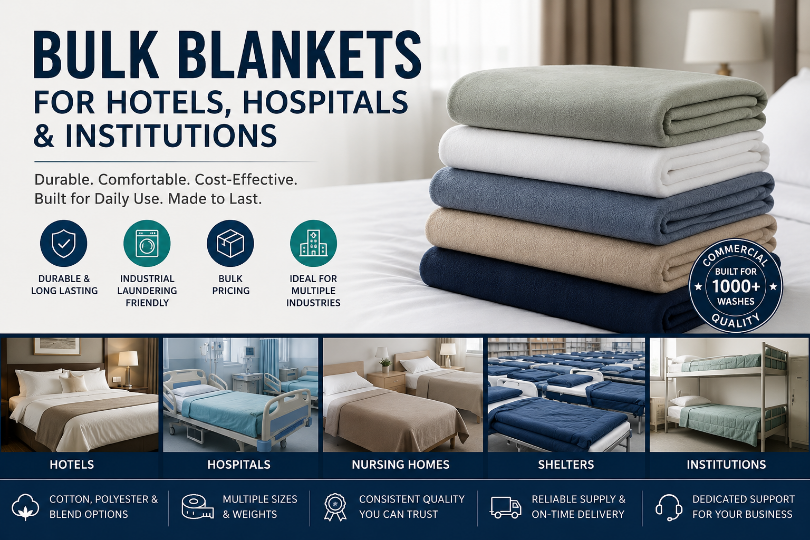
Hotels, hospitals, nursing homes, shelters, and the like have institutional blanket needs that diverge significantly from those of the typical home. Handling daily use, washing, full rooms of people, storing, and replacing all affect what bedding really costs. Bulk blankets provide purchasing groups with a practical tool to standardize the product, keep inventory levels manageable, and choose commercial constructions that meet the high demands of facility operations.
Understanding the Product
Commercial blankets are the end result of the operational needs of hospitality, healthcare, and institutional environments. In contrast to many home blankets, commercial blankets are chosen based on the material used to make them, how much they weigh, how they’re constructed, how large they are, how they should be laundered, how durable they are, and how often they need to be replaced. HY Supplies has a broad selection of cotton, polyester, blended, and cotton/polyester blankets in a variety of weights and sizes. The critical difference is not just whether a blanket is comfortable on first use. Commercial purchasers require a product that will work with their facility laundering process and storage system, fit their beds, provide the right amount of warmth, and be within their replacement budget.
Why the Industry Uses This Product
A 200-room hotel doesn’t buy 200 blankets and call it a day. Operations require a reserve stock for housekeeping turnover, damaged merchandise, laundry rotation, seasonal demand, and surprises in occupancy. Hospitals have the same need, with blankets shifting from patient rooms to laundry to storage to distribution.
The operational advantage becomes more important when laundering is frequent. Healthcare laundry processes depend on multiple factors, including time, temperature, mechanical action, water quality, load volume, degree of soiling, and the equipment being used. The CDC recommends following textile care instructions and maintaining laundry equipment according to manufacturer instructions.
Key Benefits
Cost Control
Unit cost is only a portion of blanket costs. Procurement teams need to take into account the number of times the item will be laundered, how often it needs to be replaced, the amount of labor required to handle the stock, and the cost of holding emergency supplies.
Bulk purchasing may also increase purchasing consistency and reduce the number of replenishment orders. HY Supplies has tailored its blanket range with bulk purchasing and commercial restocking in mind.
Durability and Replacement Reduction
Construction matters when blankets are repeatedly washed and handled. Snag-free and tightly constructed products are particularly useful where catching, tearing, or premature surface deterioration creates unnecessary replacement.
The category includes products marketed for durability and repeated industrial laundering, including snag-free thermal blankets and commercial hospital blankets.
Inventory Efficiency
A blanket program standardizes makes for easier inventory counting. A hotel may define a size and weight for each room type, and a healthcare organization may define preferred blanket specifications for patient-care rooms and other areas.
The purchasing departments need to hold sufficient quantity to satisfy the normal demand, the laundry rotation, and the unpredictable reserve. The appropriate buffer size is based on the occupancy rate, number of beds, laundry turnover, seasonal demand, and rate of historical loss.
Lifecycle Cost
A lower-priced blanket option is not the least expensive option. If it needs to be replaced frequently, its cost on a yearly basis can be higher than that of a more robust commercial product.
A useful purchasing calculation is:
Annual blanket cost = purchase cost + laundering cost + handling cost + replacement cost
This approach gives procurement teams a more realistic view of value than comparing unit prices alone.
Choosing the Right Product
Fabric composition should match the operating environment. Cotton can provide a familiar natural hand feel, while polyester and cotton/polyester blends can offer different combinations of durability, care requirements, and cost. HY Supplies' catalog includes all three construction categories.
Weight is just as important. A lightweight thermal blanket may be appropriate for use in a facility that only needs to provide a small amount of warmth and where the blanket is easily managed. Heavier blankets are suitable in the case where the warmth requirement is greater; however, they will impact the size for storage, size of laundry loads, drying time, and handling.
Size must be appropriate for the bed or the application. The range now extends from small receiving blankets all the way to twin, full, queen, and king sizes and beyond to larger institutional sizes.
The purchasing arms of the ministries should check for any institution-specific fire-safety/textile requirements prior to making the purchase. No assumptions should be made that a general commercial blanket meets a certain flame-resistance standard. Compliance requirements should be tailored according to the facility, jurisdiction, and product documentation.
Hotels and Hospitality
Hotel blankets should be suitable for warming every room in the hotel and withstand multiple housekeeping turnovers. Hotel blankets wholesale can be particularly useful for hotels that want uniform sizes and constructions across all rooms.
Stock planning should be informed by the number of occupied rooms, laundry turnaround time, housekeeping par levels, seasonality, and replacement stock. An establishment offering more than one type of category, for that matter, might also require more than one set of blanket sizes or thicknesses.
For hospitality procurement, the practical question is whether the blanket continues to perform acceptably after repeated use—not simply whether it looks attractive when new.
Hospitals and Healthcare Facilities
The textile-handling needs of hospitals, nursing homes, convalescent homes, and clinics are more exacting. Bulk hospital blankets enable facilities to standardize on a product while maintaining enough blankets to meet the daily requirements of patient care.
Healthcare laundries must keep soiled and clean textile processes separate and adhere to recognized handling standards. Handling CDC recommendations highlight
- Controlled Handling
- Appropriate containment
- Commercial laundry process
- Complete drying
- Protected deposition of clean linen.
Other Institutional Applications
Colleges, dormitories, shelters, rehabilitation facilities, government programs, and emergency-response organizations may require substantial quantities of blankets without the same room-by-room presentation requirements as hotels.
HY Supplies lists applications including shelters, rehabilitation centers, colleges, and institutional facilities, and its range includes multiple sizes, weights, and constructions.
For these buyers, inventory availability and rapid replenishment can be just as important as fabric selection. Emergency programs, for example, need products that can be stored, distributed, and reordered in predictable quantities.
Commercial Laundry and Maintenance
Commercial washing and drying should start with the manufacturer's care instructions. Water temperature, detergent choice, mechanical action, drying temperature, load size, and fabric type influence the life of the textile.
Healthcare laundry processes require that clothes be handled differently. Factors such as time, temperature, mechanical action, water quality, load size and type, and equipment influence the effectiveness of laundering, according to CDC guidance. Storage and transport of clean textiles should also protect against contamination.
Facilities should monitor:
- Shrinkage after repeated washing
- Seam and edge condition
- Surface snagging or pilling
- Color retention
- Drying performance
- Damage rates
- Average replacement interval
Product Comparison
|
Hand feel |
Natural |
Balanced |
Soft/plush |
|
Durability |
Good, product dependent |
Generally strong for commercial use |
Product dependent |
|
Weight options |
Broad |
Broad |
Broad |
|
Laundry considerations |
Follow product care instructions |
Follow product care instructions |
Often requires attention to drying settings |
|
Best fit |
Hotels, institutions |
Hospitals, hotels, institutions |
Dormitories, assisted living, hospitality |
What is best will depend on your facility's priorities. Cotton also has its attractions when natural fiber is required. Blends can be made to balance fiber properties and commercial processing. Polyester fleece is good for applications where lightweight warmth and a soft feel are needed. Specific product-level guidance should always override general fiber-based assumptions.
Procurement Considerations
The purchasing departments should determine the par and rate of replacement levels before placing an institutional order.
For example, a 150-room hotel may have an inventory of more than 150 blankets, as this is dictated by rooms in service, laundry rotation, damaged items, and backup stock. A 300-bed healthcare facility would similarly perform this calculation by factoring in its patient bed count, turnover of patients, turnaround of laundry, and needs by department.
The procurement model should consider:
- Facility or room count
- Required blanket dimensions
- Preferred fabric construction
- Weight requirements
- Laundry capacity
- Storage capacity
- Expected replacement cycle
- Seasonal demand
- Reorder frequency
- Supplier availability
- Total Cost of Ownership
This turns blanket purchasing from a simple unit-price exercise into a controlled textile-management program.
Common Buying Mistakes
The most common procurement mistake is purchasing based entirely on the lowest initial price. A cheaper blanket that requires frequent replacement can create higher long-term costs.
Other mistakes include selecting residential-grade products for commercial laundry, overlooking size requirements, failing to account for reserve inventory, mixing incompatible constructions across a facility, and assuming that all blankets have identical care requirements.
Buying Checklist
Before approving an order, verify:
- Material and fabric composition
- Blanket size
- Weight
- Construction and edge finishing
- Commercial laundering compatibility
- Care instructions
- Durability requirements
- Applicable fire-safety requirements
- Required inventory level
- Replacement and reorder schedule
- Supplier stock availability
- Bulk-order capability
- Delivery requirements
Choosing a Reliable Wholesale Supplier
A supplier relationship should be assessed beyond the initial transaction. Business customers rely on product specifications they can count on, consistent product availability, accurate case quantities, responsive account support, and realistic lead time information.
Procurement teams should still confirm current stock, specifications, case quantities, and delivery timing for each purchase because availability can vary by product.
Conclusion
In hotels, hospitals, and institutions, premium wholesale blankets are best utilized when managed as an operational textile asset rather than a simple bedding expenditure. The appropriate blend of fabric, weight, construction, size, laundering compatibility, inventory planning, and supplier consistency can positively affect daily operations and help manage replacement and handling costs.
For purchasers assessing the needs of a commercial bedding application, please view the current blanket range or request product information and a bulk quote based on your facility's quantities and requirements.