



Waterproof Protective Bedding and Mattresses
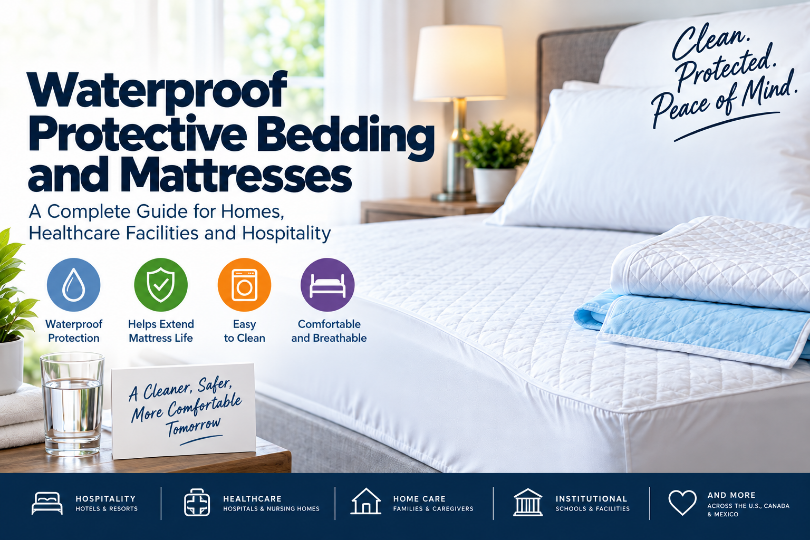
Waterproof Protective Bedding and Mattresses: A Complete Guide
Water, spills, incontinence, and other mishaps can wreak havoc on mattresses, pillows, and bedding. Protective bedding offers a useful layer of protection between the moisture and the mattress or pillow beneath for the residential user as well as the hotel, healthcare, nursing home, and home care provider. In this Buying Guide, you will learn how waterproof protective bedding works, what types of products are available, and what to look for in protective bedding for everyday and high-usage.
What Is Waterproof Protective Bedding?
Waterproof protective bedding is designed to help prevent liquids from reaching the mattress, pillow, or other underlying bedding. Depending on the product, protection may come from a waterproof membrane, coated fabric, laminated backing, or another barrier construction.
A barrier layer can perform two functions: it can block moisture from entering the mattress below, and it can facilitate routine cleaning. This is especially helpful when cleaning or replacing the mattress is difficult or cost-prohibitive.
It’s also helpful to separate waterproof bedding products from a waterproof mattress. A mattress protector (also known as a mattress pad) is a thin layer of material that is placed on top of (or encases) the mattress and functions as a protective barrier. A waterproof mattress may have moisture-resistant features built into the mattress itself. In a lot of buying scenarios, the practical route is to put protective bedding on top of a regular mattress, especially since you can peel off, wash, and put back the protective layer.
Why Use Waterproof Protective Bedding?
Mattresses and pillows are hard to clean thoroughly after multiple wet incidents. An appropriate protective barrier may minimize the amount of liquid absorbed in the underlying bedding and make linen management easier.
Protecting Mattresses From Moisture
Moisture from spills, sweat, incontinence, and bedwetting may penetrate into a mattress. Repeated exposure can result in staining, odor, and damage to the surface of the mattress over time.
An additional benefit of a mattress protector is that a correctly fitting protector will act as a buffer against moisture, separating it from the mattress. It won't remove the importance of cleaning, but it sure can ease up on the amount of work to be done.
Supporting Easier Cleaning
A mattress cover or a bed pad can be taken off and washed far more easily than a whole mattress. This is of particular importance in institutions where there is a need to change and launder bedding on a more or less regular basis.
Therefore, for commercial purchasers, the ease of laundering must be weighed against the initial purchase cost.
Extending Bedding Service Life
The replacement of a mattress can be quite a bit more inconvenient than the replacement of a protective cover or pad. What is fair to say, though, is that protecting your mattress from exposure to spills and other contaminants can help extend the useful life of your bedding.
Types of Waterproof Protective Bedding
Different protective products address different parts of the bed. Choosing the right type is more effective than relying on one product for every application.
Waterproof Mattress Protectors
A waterproof mattress protector is designed to cover the sleeping surface of a mattress while providing a moisture barrier underneath the fabric.
Protectors may be fitted, zippered, or constructed in other configurations. The most appropriate style depends on how much of the mattress needs protection and how frequently the cover will be removed for laundering.
Waterproof Bed Pads
Reusable bed pads can be useful for healthcare, nursing homes, home care, and other environments where repeated laundering is part of normal operations.
HYSupplies offers protective bed pads in multiple configurations and case quantities, including products designed for healthcare and institutional applications.
Bedwetting Mattress Protectors
A mattress protector for bedwetting is designed to stop urine from seeping into the mattress. This is useful to know for your home, pediatric office, elder care, or any other place where bedwetting or incontinence is a common issue.
For recurring events, consumers need to look farther than the word “waterproof.” How absorbent a product is, how much coverage it provides, its fit, how much washing it needs , and how long it takes to dry can all be just as important.
Fluid-Resistant Pillow Protectors
Moisture protection should not stop at the mattress. Pillows can also be exposed to perspiration, spills, stains, and other contaminants.
A fluid-resistant pillow protector adds another protective layer between the pillow and pillowcase. Depending on the construction, pillow protectors may also help protect against dust, stains, and everyday wear.
Mattress Toppers
A mattress topper and a waterproof mattress protector perform different jobs.
A topper is primarily used to change the feel or cushioning of a mattress. A protector is primarily intended to protect the mattress from moisture, stains, and everyday wear. Some bedding systems can use both: the topper for comfort and a compatible protective layer for moisture protection.
This distinction is important when searching for the best mattress topper. The “best” topper depends on the desired comfort and support characteristics; waterproof protection should be evaluated separately unless the particular topper is specifically designed for that purpose.
Waterproofing Technology: What Should Buyers Look For?
The construction of the moisture barrier has a major effect on how protective bedding feels and performs.
Waterproof vs. Water-Resistant
These terms should not be treated as interchangeable.
A waterproof construction is designed to prevent the penetration of liquid under certain conditions, whereas a water-resistant material only partially resists the penetration of liquid and will eventually let it through.
Common Barrier Materials
Protective bedding can use different barrier technologies, including coated or laminated materials and polymer-based waterproof membranes.
Polyurethane, commonly abbreviated as PU, is used in some protective bedding because it can provide a liquid barrier while allowing manufacturers to create relatively flexible constructions. Vinyl is another material used in certain waterproof bedding products.
Breathability
A waterproof layer does not necessarily have to feel excessively hot or uncomfortable. Breathability depends on the materials and construction used throughout the product.
For bedding that is in contact with the sleeper for a long duration, keep in mind the considerations of moisture protection, airflow, fabric feel, and use case.
How to Choose the Right Waterproof Protective Bedding
The right product depends on the environment and the type of protection required.
1. Identify the Source and Amount of Moisture
A mattress exposed to occasional spills has different requirements from a bed used for recurring incontinence care.
Guide your choice by what is most important for you to address:
* Occasional spills
* Bedwetting
* Incontinence
* Perspiration
* General stain protection
* Fluid exposure in healthcare or institutional settings
This can help you decide if a mattress protector, an absorbent bed pad, an encasement, or a combination of these products is needed.
2. Choose the Correct Size and Fit
A protector that doesn't fit can slip during use and expose parts of the mattress.
Please make sure you check the mattress measurements, pocket depth requirements, and closure style prior to purchasing. For the institutional buyer, standard mattress dimensions can simplify the process of purchasing replacements and stocking.
3. Consider Absorbency
Water-resistant and absorbent are not the same.
Waterproof backing keeps the fluid from going through, and an absorbent top layer holds the moisture. So, for a bed pad to cater for heavy moisture management, it might have multiple layers for surface comfort, absorbency, and protection from the backing. HYSupplies 3-layer quilted bed pads feature a soft upper layer, an absorbent middle layer, and a waterproof backing.
4. Consider Durability
For high-use applications, durability should be considered in addition to comfort and waterproof performance.
Consider the quality of the seams, elastic, closures, backing, and fabric. Even if a product has a lower initial purchase price, a product that cannot withstand a facility’s normal laundry cycle may have a higher total cost.
Waterproof Protective Bedding for Commercial and Institutional Use
Protective bedding has particular value in environments where mattresses and pillows are used by many people or must be maintained according to consistent housekeeping and care procedures.
Healthcare Facilities and Hospitals
Patient care areas in healthcare facilities, such as patient rooms, recovery rooms, long-term care facilities, and home care may employ protective bedding.
Hospital bed pads can be of particular help with localized moisture control. Product specifications and requirements should be aligned with the care environment, the laundering procedure, mattress size, and the protocols of the institution.
Nursing Homes and Elder Care
There are repeated needs for protective bedding in long-stay care settings. Reusable bed pads and waterproof mattress covers enable the normal circulation of bed linen and the protection of the mattress from wetting.
The purchasing departments should take into account the number of beds to be protected, frequency of replacement, laundry capacity, and the reserve stock.
Buying Waterproof Bed Pads Wholesale
For facilities with recurring requirements, waterproof bed pads wholesale purchasing can simplify procurement and inventory planning.
Bulk purchasing can be useful when multiple rooms or beds use the same product. However, buyers should compare more than the unit price.
Consider:
- Units per case
- Available sizes
- Product construction
- Expected laundry frequency
- Replacement rate
- Shipping and delivery requirements
- Storage capacity
- Availability for future reorders
A lower unit price is not necessarily the lowest overall cost if a product has a short service life or does not perform well under the facility’s normal conditions.
For larger orders, requesting product specifications or samples before committing to a substantial quantity can reduce the risk of selecting an unsuitable construction.
Final Considerations
There's not one waterproof protective bedding, and there isn't one perfect answer to the question “What type of waterproof bedding is best?” Mattress protectors, waterproof bed pads, pillow protectors, mattress covers, and toppers each have a different function.
The best option begins with the use. Think about the source of moisture, what level of protection you need, absorbency, type of waterproof fabric, size of your mattress, bedding comfort, washing process, long life, and how many of these you plan to buy.
These considerations take on an additional dimension when you’re dealing with healthcare facilities, nursing homes, hospitality properties, and the like. Choosing products that properly fit the beds, survive the anticipated care cycle, and are restocked reliably—and such items certainly exist—can help make protective bedding more manageable over time.
A well-chosen protective layer is not a substitute for cleaning and upkeep, but it may offer a useful extra shield between the everyday damp and the bedding beneath.