




How Do Hospitality Sheets Improve Guest Comfort and Hotel Operations?
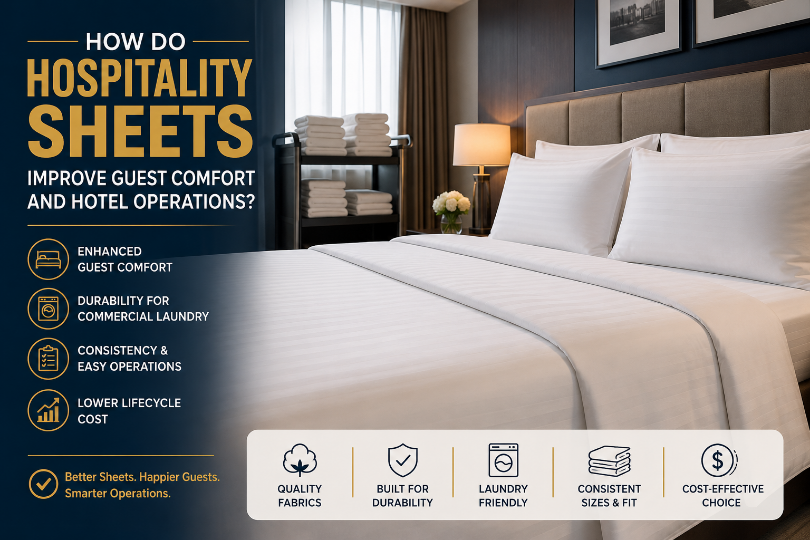
Hotels have to satisfy two competing demands every day: guests want a clean and comfortable bed, and the operations team requires bedding that holds up to many layers of laundering, room turnover, and handling. Premium hospitality sheets bridge those needs. Sleep comfort, laundry performance, and replacement frequency can be affected by fiber content, weave, finishing, sizing, and construction. Procuring bedding, for the purchasing team, is therefore not just a case of picking a nice soft material. It is a lifecycle choice that touches guest experience, operational consistency, inventory management, and cost of ownership.
Understanding Hospitality Sheets
Hospitality sheets are the bed sheets that are used in hotels, motels, and other accommodations. Commercial bedding differs from home sheets in that it is selected for its durability to withstand constant laundering, availability in standard sizes, ability to be replaced easily, and daily use.
Some of the most popular materials are cotton, polyester, and cotton-polyester blends. Weave, yarn quality, finishing, seam strength, size stability, and fabric weight all influence sheet performance. Thread count is useful for comparing products, but it’s not the only one to consider in determining commercial grade.
Why the Hospitality Industry Uses Commercial Bedding
Hotel bedding goes through much more use than home bedding. Staff is constantly stripping, washing, drying, folding, checking, storing, and reusing sheets all year long.
The procurement priorities arising from this operating cycle are as follows:
* Uniform dimensions for repeated orders
* Ability to withstand commercial laundering multiple times
* Dependable color and look
* A good feel against the guest’s hand
* Simple to sort and manage inventory
* Anticipated replacement levels
* Dependable availability in quantity
In a 200-room hotel, a small variation in sheet longevity can mean a big change in your buying requirements. When sheets wear out too quickly, the expenses are more than just the cost of the fabric. Staff also use up time receiving, auditing, sorting, storing, delivering, and picking up soiled sheets.
Key Benefits of Choosing the Right Commercial Sheets
Guest Comfort
Guests spend much of the night in direct contact with the bedding. So, the feel of the fabric, how well it breathes, its smoothness, fit, and temperature all matter.
Cotton fabrics are typically chosen for their natural feel and breathability, and cotton-polyester blends are able to offer a useful blend of comfort, dimensional stability, wrinkle control, and durability.
Durability and Replacement Control
Sheets for commercial use must be able to withstand frequent washing without becoming too thin or breaking at the seams or shrinking or fading.
A sheet that costs more initially can be a better value if it lasts longer and requires less frequent replacement. Instead of just looking at the price per sheet, procurement teams should consider the cost per use.
Laundry Efficiency
How the fabric is made affects how sheets wash, dry, fold, and finish. Sheets that keep their shape and don’t wrinkle too much are easier to handle later on.
Laundry results should be checked using the hotel’s real washing process, not just general advice. Things like water temperature, chemicals, washing action, drying, and finishing equipment all affect how long sheets last.
Inventory Consistency
Using the same sheet sizes and types across all rooms makes housekeeping easier. Staff spends less time sorting and matching sheets when everything is consistent.
This becomes particularly important when properties operate multiple room types or purchase replacement inventory throughout the year.
Lifecycle Cost
The true cost of commercial bedding includes not just the purchase price, but also shipping, storage, laundry, labor, replacements, and keeping extra inventory.
So, when choosing commercial bed sheets, procurement teams should compare how long sheets will last and what they need to work well, not just the price.
Choosing the Right Sheet Construction
The selection of the best sheet will vary based on the hotel’s model.
Fabric: Cotton is soft and natural, while polyester and blends are more rugged and hold their shape. Blends are typically preferred when sheets are laundered frequently and need to hold up.
Weave: Percale and sateen weaves have different feels. Buyers should combine feel, durability, laundering performance and property positioning to form their own opinions.
Weight: Heavier material is not necessarily superior. Too much weight can influence drying time, processing and laundry expense. The goal is to have the right balance of strength and workability.
Thread count: Keep an eye on thread count when purchasing hotel sheets. A higher thread count does not necessarily mean better commercial performance. Fiber quality, yarn structure, weave, finishing and fabric engineering can also play a part in durability and feel.
Sizing: Dimensional uniformity is important. Sheets should fit the mattress sizes of the property, and after multiple washes still be the right size.
Hotel Applications and Operational Considerations
Hotels and Resorts
Hotels usually demand uniformity in sheets for its rooms due to the number of rooms. Procurement teams should define specs by mattress size, room type, and service level while keeping adequate par stock to cover occupied rooms, laundry cycles, and contingency needs.
Motels and Extended-Stay Properties
They tend to favor durability and replacement control. A mechanical combination construction could be attractive if sheets are subjected to frequent washing and high occupancy.
Boutique Hotels and Luxury Properties
Higher-end properties generally expect better hand feel, appearance, finishing and presentation. Procurement can require premium constructions and still verify their performance via laundering testing.
Wedding Venues and Banquet Properties
While such facilities do not have standard guest rooms, venues with overnight accommodation/lodging partners may need to coordinate bedding supplies. Uniform sizing and replacement scheduling prevent the procurement of supplies at the last moment.
Country Clubs and Golf Clubs
Guest bedding should be able to travel easily between rooms without breaking presentation in clubs that have guest accommodations, member lodging, or hospitality suites. Standardizing inventory makes housekeeping and purchasing easier.
Healthcare and Institutional Facilities
Some institutional settings employ commercial or industrial bedding which may have different performance expectations than hotels. Healthcare facilities should write their own specs to meet their infection-control, laundering, and regulatory needs and not simply assume that hotel bedding specs are appropriate.
Commercial Laundry and Maintenance
The manufacturer's care instructions should always be reconciled with the property's commercial laundry formula.
Key maintenance considerations include:
- Use wash chemistry appropriate for the fabric construction.
- Avoid excessive mechanical action where it is unnecessary.
- Control drying conditions to reduce avoidable thermal stress.
- Monitor shrinkage during initial and subsequent wash cycles.
- Inspect seams, hems, and corners during linen processing.
- Separate heavily worn inventory before it affects guest-facing presentation.
- Store clean sheets in a dry, controlled environment.
- Rotate inventory systematically rather than repeatedly using the same stock.
Commercial Sheet Comparison
|
Feature |
Cotton |
Cotton-Polyester Blend |
|
Guest Hand Feel |
Natural, breathable |
Soft with practical performance |
|
Commercial Durability |
Good, depending on construction |
Often strong for high-turnover use |
|
Dimensional Stability |
Requires careful laundering |
Generally strong |
|
Wrinkle Management |
Moderate |
Generally easier |
|
Laundry Considerations |
Can require greater shrinkage control |
Often easier to manage |
|
Typical Application |
Premium and comfort-focused properties |
High-volume commercial operations |
Procurement Considerations and Total Cost of Ownership
A hotel purchasing team should begin with the property's actual operating data.
Consider a 100-room property operating at high occupancy. The required inventory is not simply 100 sheets per size. Procurement must account for beds in service, sheets in laundry, clean reserve stock, damaged inventory, seasonal demand, and emergency replacement requirements.
The same principle applies when expanding a property. Buying the exact number of sheets required for current rooms can create shortages during peak occupancy or laundry disruptions.
A useful procurement model considers:
- Number of rooms and beds
- Mattress and sheet sizes
- Occupancy patterns
- Laundry turnaround time
- Par level requirements
- Expected replacement rate
- Storage capacity
- Supplier lead time
- Minimum order quantities
- Cost per usable service cycle
This approach provides a more meaningful hotel bedding quality assessment than comparing specifications in isolation.
Common Buying Mistakes
Choosing residential-grade bedding: Retail sheets may provide excellent comfort initially but may not be engineered for the property's commercial laundering process.
Buying solely by thread count: Thread count does not capture fiber quality, weave, yarn strength, finishing, or seam construction.
Ignoring dimensional stability: Excessive shrinkage can create fit problems and accelerate replacement.
Underestimating par levels: Insufficient reserve inventory creates pressure during peak occupancy and laundry delays.
Changing specifications between orders: Inconsistent replacement stock can create differences in color, sizing, hand feel, and appearance.
Focusing only on unit price: A lower purchase price can become expensive if replacement frequency is significantly higher.
Commercial Bedding Buying Checklist
Before placing a bulk order, confirm:
- Material and fiber composition
- Weave and fabric construction.
- Mattress and sheet dimensions
- Fabric weight
- Thread-count specification where relevant
- Shrinkage performance
- Seam and hem construction
- Commercial laundering compatibility
- Color and appearance consistency
- Expected durability
- Inventory requirements
- Supplier stock availability
- Bulk-order capacity
- Delivery lead times
- Replacement-order consistency
- Product samples or pre-production approval
For properties that have specialized requirements for fire safety, verify the requirement with the authority having jurisdiction, and obtain documentation relying upon applicable test documentation. NFPA 701 is a standard for fire tests for assessing the flame propagation of textiles and films; however, it should not be used as a certification that covers all textile products or uses.
Choosing a Reliable Wholesale Supplier
A reliable wholesale hotel linen supplier should consider more than just the cost. Procurement teams need to be assured that subsequent orders will be consistent in specification and that the supplier can meet the volume requirements.
Important supplier criteria include:
- Stable product specifications
- Quality-control procedures
- Consistent inventory
- Bulk fulfillment capability
- Clear product documentation
- Reliable lead times
- Responsive customer service
- Sample availability
- Ability to support repeat purchasing
- Experience with commercial hospitality requirements
For multi-property operators, supplier consistency becomes even more important. A centralized specification and approved-product list can reduce purchasing variation across locations.
Final thoughts
Proper specification of bedding contributes to both aspects of hotel performance: the experience of the guest, and the operating model that delivers it. Suitable fabric construction may increase comfort while delivering on the support for multiple washes, standardization of inventory, planning of replacement, and predictable lifecycle costs.
Hotels need to test hospitality sheets under actual working conditions, including commercial laundry, inventory, and anticipated service life. To validate the right construction before investing in a large stock purchase, procurement teams can ask for product specifications, fabric samples, and bulk-order information from a knowledgeable hospitality textile provider.