



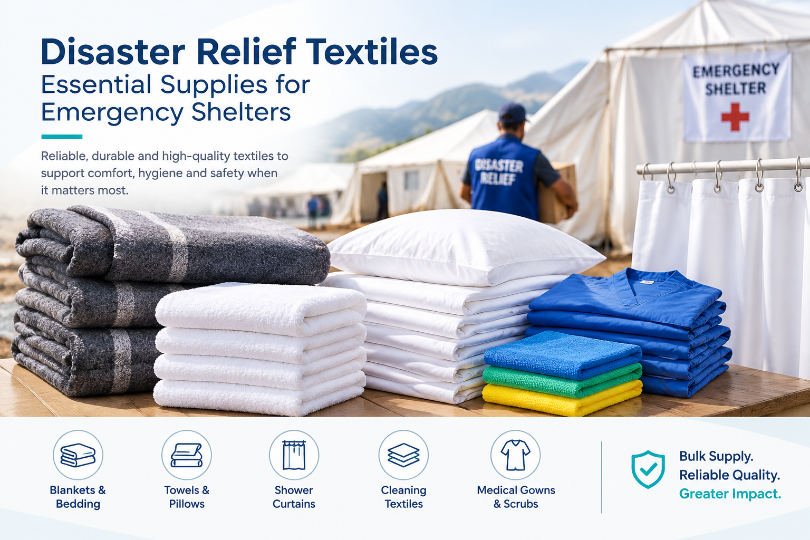
Disaster Relief Textiles: Essential Supplies for Emergency Shelters
When an emergency shelter opens, textiles quickly become essential infrastructure: people need a clean surface to rest on, heat, towels for personal hygiene, and fabrics for medical applications and cleaning. For purchasing teams, the challenge is not simply buying a lot. It is identifying products that can be airdropped, used, washed, stored, and replaced many times.
Disaster relief textiles therefore need to be evaluated as operational supplies, not ordinary household linens. Material selection, construction, laundering requirements, inventory levels, and supplier reliability all affect the cost and effectiveness of an emergency shelter program. HY Supplies' dedicated category includes blankets, sheets and pillowcases, towels, pillows, shower curtains, cleaning towels, medical gowns, and medical scrubs for emergency shelter operations.
Understanding the Product
Unlike home textiles, shelter stock is bought in bulk and to more consistent specifications, with provisions for recirculation, sanitation, warehousing, and replenishment cycles. For example, in FEMA guidance on sheltering items, blankets are considered a basic sheltering item, and a convergent shelter population of 100 people is used as a planning factor.
Commercial textile programs also need to distinguish between products that serve different functions. A thermal blanket provides warmth; a sheet creates a hygienic barrier around a sleeping surface; a towel supports personal hygiene and cleaning; and a shower curtain provides privacy and helps contain shower areas. HY Supplies specifically identifies these functions within its emergency-shelter assortment.
Why the Industry Uses This Product
Shelter procurement has a different profile than hospitality or institutional purchasing. Demand can spike dramatically, storage may be temporary, and products can be subjected to rough handling in a short time span.
For a buyer in this procurement type, continuity counts as much as the up-front cost. A shelter operator, for example, may require hundreds or thousands of items that can be tracked, issued, laundered, stored, and replenished through a predictable system.
The Textile program must also encompass hygiene. HY Supplies states that their shelter bedding and towels are designed to be washed and sanitized, and that their emergency medical gowns and scrubs meet the contamination-control requirements for healthcare staff and patients.
Separate consideration should be given to fire safety. NFPA 701 is a test method for flame propagation of textiles and films and should not be interpreted as a blanket good for every textile in a tent emergency shelter. Applicability is dependent on the use of the textiles, the facility code, and the authority having jurisdiction.
Key Benefits
Cost control
The lowest unit price does not necessarily mean the lowest purchasing cost. A fabric that needs to be changed often, causes washing problems, or is hard to keep can raise overall operating costs.
Buying in volume can improve price efficiency for predictable items such as sheets, pillowcases, towels, and blankets. HY Supplies touts its disaster-relief collection, including bulk emergency towel supplies, and its larger B2B purchasing model.
Durability and replacement reduction
Many processes are involved in handling shelter textiles. Bedding can be distributed, collected, laundered, folded, stored, and redistributed multiple times.
So the construction is important. When purchasing, buyers need to look beyond composition and consider fabric type and weave, as well as hems, seams, edge finishing, and whether the fabrics can be laundered.
Inventory efficiency
This enables standardized sizes and products, which in turn makes distribution easier. Centralized purchasing and replacement forecasting are also easier, as all shelter locations use the same sheet dimensions or blanket specifications.
Operational consistency
A uniform textile pack enables staff to plan predictable distribution amounts, laundry cycles, storage methods, and replenishment triggers.
Lifecycle value
The correct quantity is the total cost of ownership, including acquisition, laundering, storage, handling, loss, and replacement. A higher initial cost may be justified if the product has a longer useful life and a lower replacement rate.
Choosing the Right Product
The right fabric depends on the environment and the shelter's activity level.
Fabric: Select according to intent rather than assuming one fiber fits all applications. Bedding, towels, thermal blankets, and privacy fabrics have different performance requirements.
Artistry: Look at the hems, joins, edges, fastenings , and general artistry. These elements define how the item holds up after a couple of washes and wears.
Weight: Take into account the empty weight. A lighter blanket is more portable, and a denser weave will keep you warmer. Make your choice based on the weather, shelter conditions, storage space, and mode of transport.
Usability: Absorbency for towels, warmth for blankets, comfort for bedding, and privacy and containment for shower curtains.
Commercial durability: For products expected to be laundered frequently, make sure the fabric suits the intended laundering conditions.
Compliance: Don’t assume a fabric satisfies a fire, healthcare, sanitation, or institutional requirement just because it is sold for commercial use. Check the relevant specification and any documentation needed for the particular application.
Emergency Shelters
Shelters provide the initial setting for a harmonized textile-related service. Sleeping areas need sheets, pillowcases, blankets, and pillows. Toilet areas need towels for personal hygiene and privacy curtains for shower areas. Clean towels are necessary to keep facilities clean on an ongoing basis.
Buying power is substantial when treating these as a single-stock system. Instead of responding to each shortage, an organization can set minimum stock levels for each fabric type and restock based on shelter population and turnover.
HY Supplies' emergency category specifically groups these products, including thermal blankets, sheets and pillowcases, towels, pillows, shower curtains, and cleaning towels.
Healthcare and Medical Operations
Disasters large and small frequently generate, or run parallel to, the need to shelter people, which creates a need for healthcare. Then textile demands go beyond bedding.
Healthcare workers rely on medical gowns and scrubs, and patients and shelter residents need bedding and towels. HY Supplies lists emergency medical gowns and medical scrubs in the disaster-relief range.
However, shelter management teams should segregate medical textiles from general shelter stock if separation is needed for washing, contamination control, clinical protocol, or other reasons.
Government, Community, and Humanitarian Facilities
Government agencies, NGOs, schools, community groups, and other organizations may activate buildings as temporary shelters. The building may not have been originally designed for continuous lodging, which makes textile logistics particularly important.
A high volume distribution site can be established in a matter of hours within a school gymnasium, community hall, or municipal building. The procurement team must plan for storage, issuance, used-fabric collection, clean-stock cycling, and restocking before the building is occupied.
Commercial Laundry & Maintenance
Laundry scheduling shall be active before the emergency stock is released. Clearly separate clean and soiled stock for reusable textiles. Define transport containers, collection points, laundering, inspection criteria, and storage.
Replacement schedules should be driven by condition and actual usage, not by an arbitrary calendar. Keep reserve stock so that normal laundering does not impact operational availability.
HY Supplies' more diverse range of healthcare textile products demonstrates why laundering compatibility is a commercial consideration: their healthcare blankets include items marketed as suitable for repeated industrial washing, but individual products have different materials, weights, and care requirements.
Product Comparison
|
Textile |
Primary Function |
Procurement Priority |
Typical Planning Focus |
|
Thermal blanket |
Warmth and insulation |
Weight, construction, durability |
Climate and population |
|
Sheet |
Sleeping-surface barrier |
Size, fabric, laundering |
Bed/cot capacity |
|
Pillowcase |
Hygiene and comfort |
Size, construction, laundering |
One per pillow plus reserve |
|
Towel |
Personal hygiene and cleaning |
Absorbency, durability |
Usage and laundry rotation |
|
Shower curtain |
Privacy and hygiene |
Construction, application requirements |
Shower capacity |
|
Cleaning towel |
Facility maintenance |
Absorbency, durability |
Cleaning workload |
|
Medical gown |
Healthcare protection |
Intended clinical application |
Healthcare staffing and patient volume |
|
Medical scrubs |
Healthcare apparel |
Fit, construction, laundering |
Staffing requirements |
No single emergency textile is a one-size-fits-all "best" solution. The appropriate specification depends on the purpose, anticipated use, laundering regime, climate, shelter design, and relevant standards.
Procurement Considerations
A realistic procurement model begins with the anticipated shelter population and duration of operation.
Take a 500-person congregate shelter, for example- you don’t just buy 500 blankets and 500 sheets. The procurement process should consider reserve stock, laundry cycles, soiled or missing items, and the possibility that use will exceed initial expectations.
FEMA sheltering guidance highlights the value of population-based planning: it provides planning estimates for shelter commodities based on a 100-person congregate shelter population in the Commonly Used Sheltering Items catalog.
Procurement teams need to indicate:
* First deployment quantity
* Reserve percentage
* Expected replacement rate
* Laundry turnaround
* Storage capacity
* Reorder point
* Lead time from supplier
* Emergency replenishment procedure
* Budget per shelter population
This changes emergency textile procurement from reactive buying to controlled inventory management.
Buying Checklist
- Procurement teams should check the following before making a bulk order:
- Material and fabric construction
- Product dimensions and sizing
- Textile weight (if applicable)
- Application
- Commercial laundering suitability
- Seam, hem, and edge construction
- Relevant fire-resistance certification or testing
- Service life
- Storage requirements
- Replacement and reserve quantities
- Supplier inventory position
- Ability to handle bulk orders
- Delivery and replenishment ability
- Product consistency over repeat orders
Choosing a Reliable Wholesale Supplier
Emergency procurement puts extraordinary demands on suppliers. A vendor must do more than have a nice catalog; buyers need confidence that specifications, inventory, fulfillment, and communication will be reliable when orders for the given quantity are placed.
Look for a supplier with established B2B ordering processes, clear product specifications, bulk-order capability, and experience serving institutional or commercial markets.
HY Supplies organizes its disaster-relief offering around distinct textile categories rather than treating emergency supplies as one generic product group. Its categories include bedding, thermal blankets, towels, cleaning textiles, shower curtains, pillows, and emergency medical apparel.
That layered category system helps buyers build an emergency textile bundle based on real-world operational needs.
Final Thoughts
The shelter textile program is functional when it is built on items that are durable, easy to clean, and managed with tight inventory control and reliable replenishment. Blankets provide warmth, bedding provides a clean sleeping area, towels promote hygiene, cleaning textiles clean the building, and Medical textiles provide specialized support to the healthcare services.
When all else fails, the most practical advice for a source is to evaluate the product's functionality for use, washing, storing, wearing, replacement interval, and life-cycle cost. Standard products and pre-established reserves also support emergency dispatch management.
Organizations preparing for disaster response should treat disaster relief textiles as part of their operational readiness strategy—not as an afterthought once a shelter has opened. Explore the HY Supplies disaster-relief textile collection to review available shelter, bedding, towel, medical, and cleaning textile categories.